
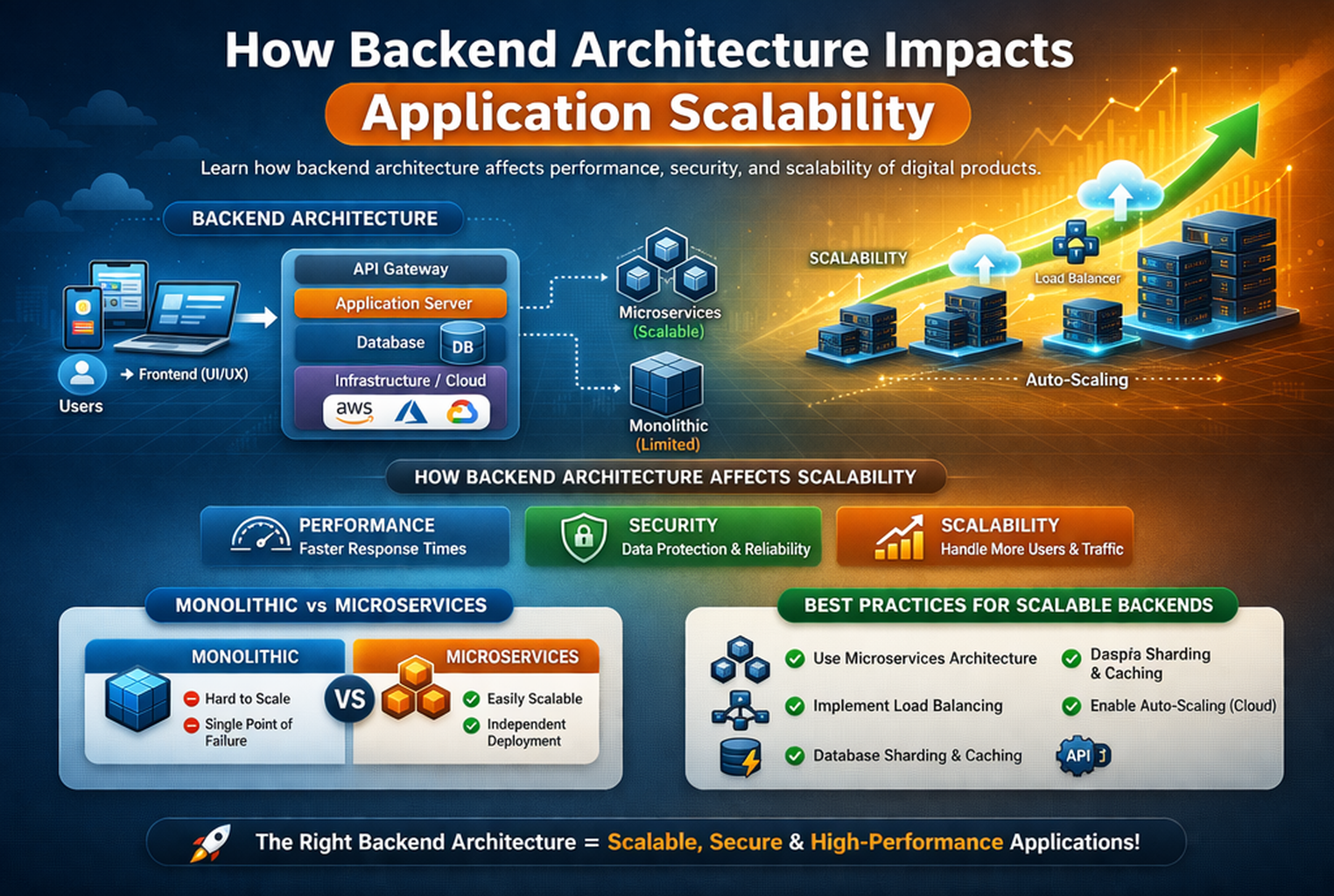
As digital products grow, the ability to handle increasing users, data, and transactions becomes critical. Many applications fail not because of poor design, but because their backend architecture wasn’t built for scale.
Backend architecture directly affects performance, security, stability, and long-term growth. Understanding how it works can help businesses avoid costly rebuilds and system failures.
Backend architecture refers to the structure that powers everything behind the user interface. It manages logic, data storage, integrations, and system communication.
The core components typically include:
When these components are designed properly, the application remains stable even as traffic increases.
Through our Backend Development Services, we design architectures that balance performance, flexibility, and long-term maintainability.
As applications grow, small inefficiencies become major problems. Without proper planning, backend systems struggle under increased demand.
Common scalability challenges include:
Poorly optimized queries slow down performance as data grows.
Large, tightly coupled systems are difficult to scale independently.
Heavy or poorly structured APIs increase response time.
Repeated database calls increase server strain.
Rapid growth without secure architecture increases risk exposure.
Performance bottlenecks often appear gradually — until sudden traffic spikes expose structural weaknesses.
Designing scalable backend architecture requires foresight and technical discipline.
Breaking systems into smaller services improves flexibility and scaling efficiency.
Indexing, query optimization, and proper schema design ensure performance stability.
Lightweight, well-documented APIs improve frontend-backend communication.
Distributing traffic across servers prevents overload.
Role-based access control and secure authentication protect sensitive data.
Scalable backend systems often work alongside optimized Frontend Development Services to ensure the user experience remains smooth even during peak usage.
Investing early in proper architecture saves time, money, and operational risk in the future.
Backend architecture is the foundation of any digital product. While users interact with the frontend, it’s the backend that determines whether your application can handle growth.
If your product is expanding, experiencing performance issues, or planning to scale significantly, strengthening backend architecture should be a priority.
© 2026 Uplift Azency