
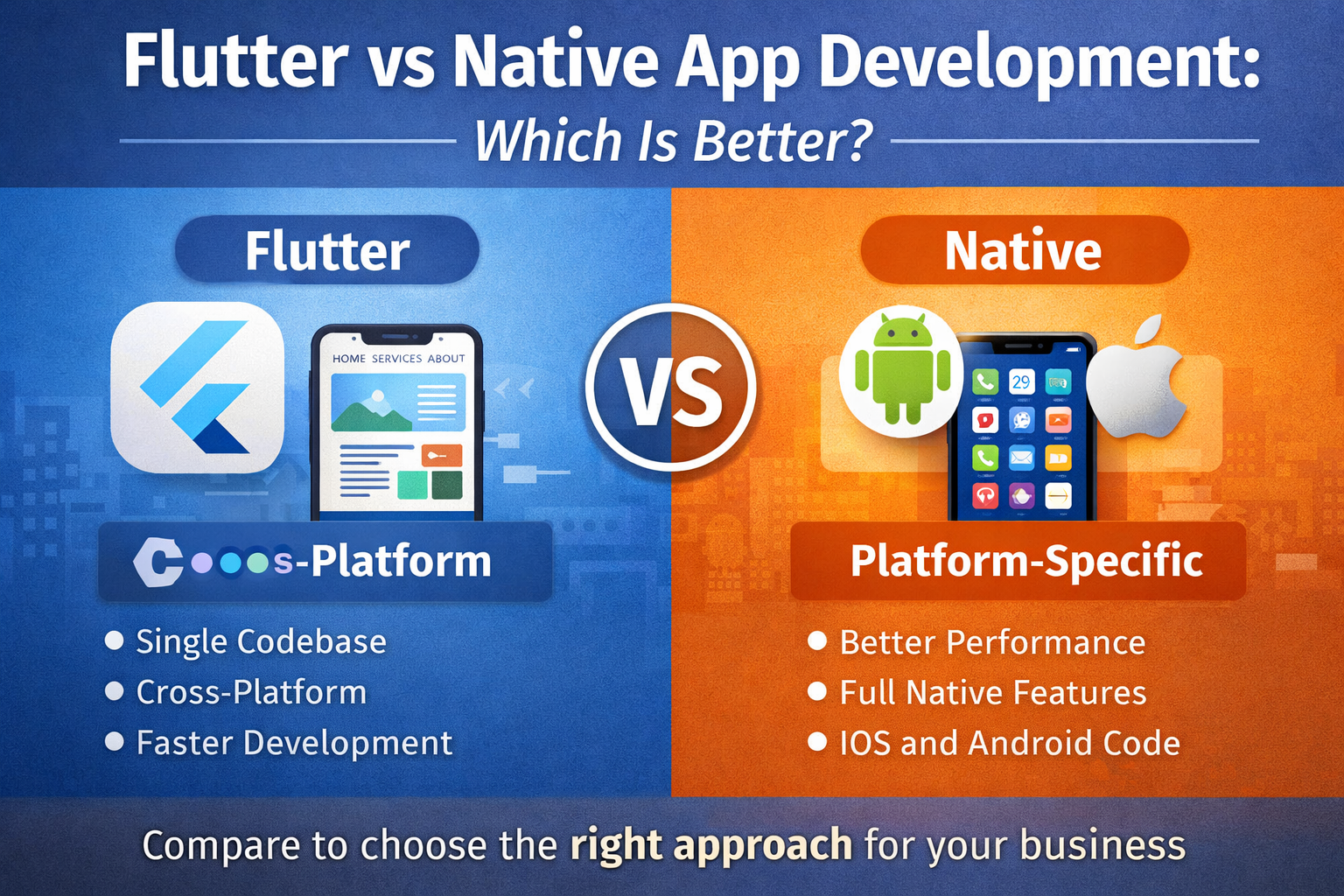
Choosing the right technology for mobile app development directly impacts performance, cost, scalability, and time to market. One of the most common questions businesses face is whether to build a Flutter app or go fully native.
Both approaches have clear advantages. The right decision depends on your goals, budget, technical requirements, and growth plans.
Flutter is a cross-platform development framework that allows developers to build apps for both iOS and Android using a single codebase. This significantly reduces development time and simplifies maintenance.
Key benefits of Flutter include:
For startups and growing businesses, Flutter is often ideal for launching MVPs quickly while maintaining strong performance standards.
Our Flutter App Development Services focus on building scalable cross-platform applications that balance speed and quality.
Native development involves building separate applications for iOS and Android using platform-specific languages (Swift for iOS and Kotlin/Java for Android).
Advantages of native development include:
Native apps are especially valuable for performance-heavy applications such as gaming platforms, financial systems, or enterprise tools requiring deep system integration.
Through our Android App Development Services and iOS App Development Services, businesses can build fully optimized applications tailored to each platform’s standards.
When deciding between Flutter and native development, consider the following factors:
Flutter generally reduces upfront costs due to shared code across platforms. Native development often requires separate teams or extended timelines.
If speed to launch is critical, Flutter enables faster deployment. Native apps typically require longer development cycles.
Flutter simplifies updates and maintenance because changes are made once. Native apps require updates across multiple codebases.
Highly complex or hardware-intensive applications may benefit from native performance optimization.
For many businesses, especially early-stage companies, starting with Flutter and scaling later can be a practical approach. Consulting experienced professionals ensures the right architectural decisions from day one.
There is no universal “better” option between Flutter and native development. The right choice depends on your business goals, user expectations, and growth plans.
If your priority is rapid development and cost efficiency, Flutter may be the ideal solution. If your application demands maximum performance and deep hardware integration, native development could be the better route.
© 2026 Uplift Azency