
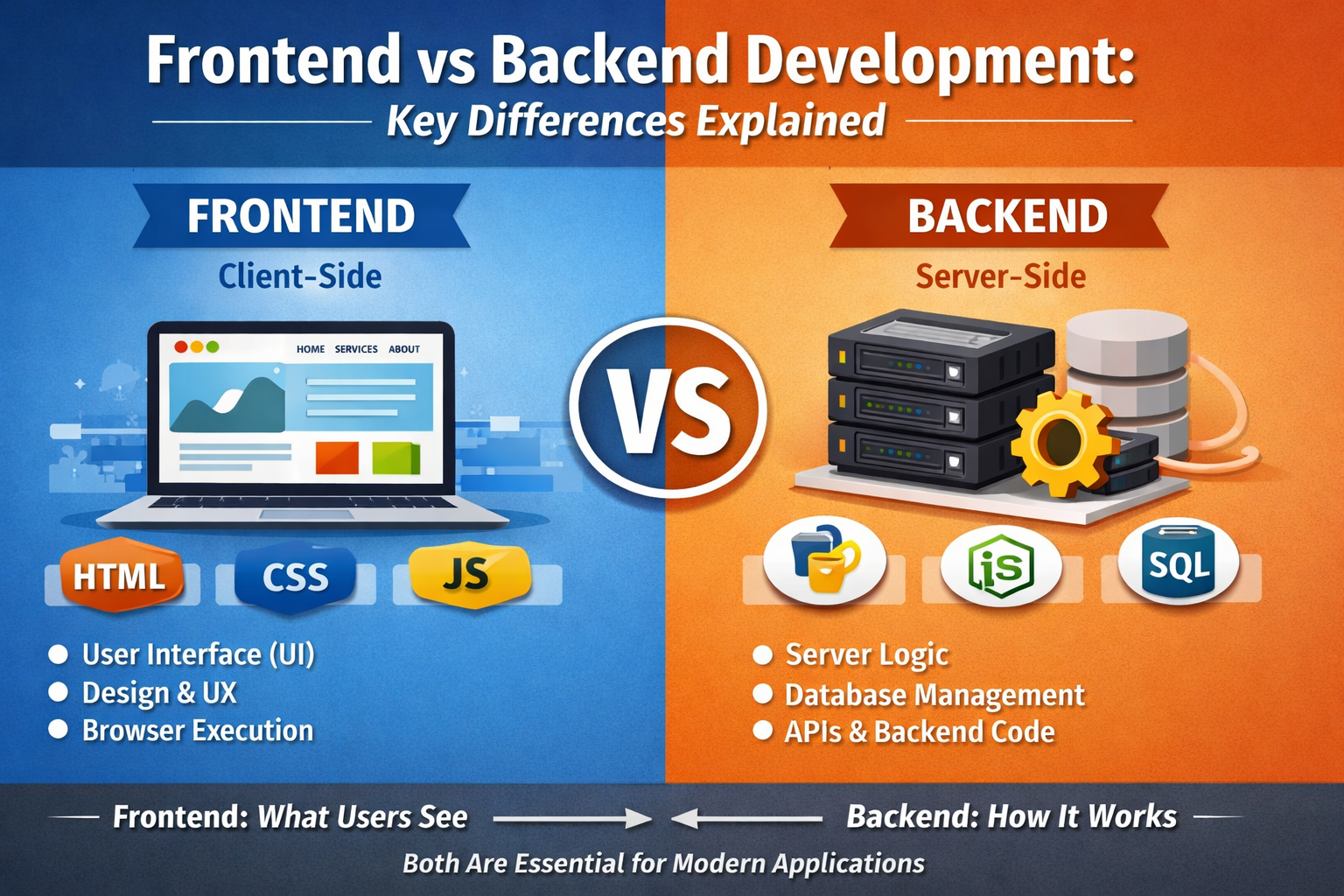
Modern applications rely on two core components: frontend and backend development. While users often interact only with what they see on screen, the real power of any application lies in how both layers work together behind the scenes.
Understanding the difference between frontend and backend development helps businesses make better technical decisions, allocate budgets wisely, and build scalable digital products.
Frontend development focuses on everything users see and interact with inside a website or application. It includes layout, design elements, responsiveness, and overall user experience.
The frontend is responsible for:
A strong frontend ensures the application is intuitive, fast, and visually consistent across devices. Modern frameworks like React and Angular enable scalable, component-based interfaces.
Our Frontend Development Services are designed to build responsive, high-performance user interfaces that align with business goals and improve user engagement.
Backend development powers the logic, databases, and infrastructure that operate behind the scenes. It ensures data is processed securely and delivered efficiently to the frontend.
The backend handles:
Without a robust backend, even the most visually appealing frontend will fail under traffic load or data complexity.
Through our Backend Development Services, we build secure, scalable systems that support modern applications and high-growth businesses.
Frontend and backend development are not separate systems — they function as a coordinated ecosystem.
Here’s how they connect:
Well-structured APIs are the bridge between both layers. Efficient communication between frontend and backend improves:
For businesses building scalable products, aligning both layers from the beginning prevents costly rebuilds later.
Frontend and backend development serve different purposes, but neither can function effectively alone. A high-performing application requires seamless collaboration between user experience design and backend architecture.
If you’re planning to build or scale a digital product, investing in both frontend performance and backend stability is critical.
© 2026 Uplift Azency